



ORGANS OF PARIS © 2026 Vincent Hildebrandt HOME ALL ORGANS



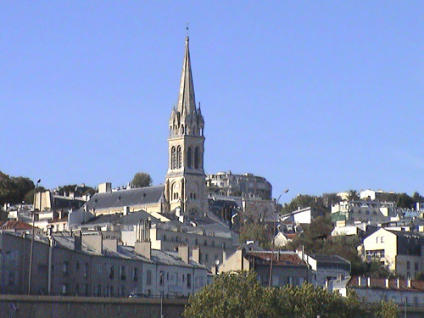
In 1787, Marie-Antoinette laid the first stone of what
would become the present church Saint-Clodoald.
Napoleon III fijnished the project in 1863. The church
is designed by Jean-François Delarue (1815-1892) in a
Romanesque Gothic style.
C3
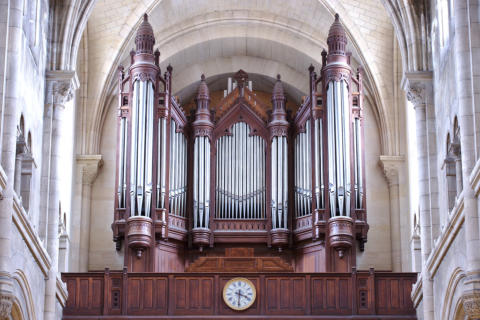
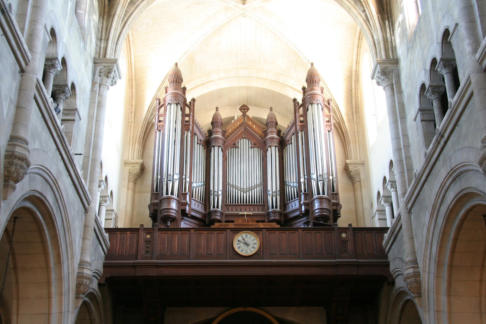
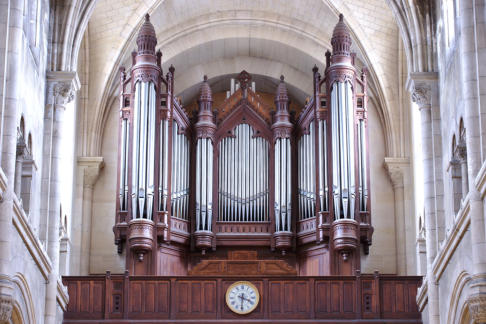
The Grand Organ of the church of Saint‑Clodoald is based on a
small standard‑series Cavaillé‑Coll instrument, ordered in
1876. The original organ, with 15 stops (19 including borrowed
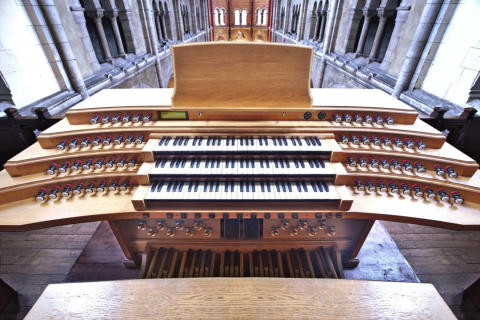
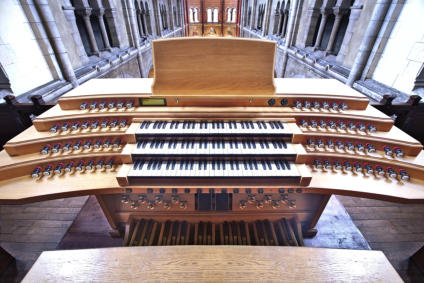
stops), had two 56‑note manuals and a 30‑note pedalboard. It
was this instrument that Charles Gounod played, as he owned
a villa in Saint‑Cloud located close to the church. Cavaillé‑Coll
revised it in 1899, adding a Clairon to the Récit and a
solid‑state pedal stop‑rail for the reeds.
The first major rebuilding took place in 1926 with Auguste
Convers: electrification and the addition of an expressive
Positif with the following stops: Flûte creuse 8, Bourdon 8,
Salicional 8, Flûte 4, Nasard, Octavin 2, Tierce, Piccolo 1,
Trompette 8, Voix humaine 8. This transformation was not a
long‑term success.
In 1956, Erwin Muller carried out a reassembly with the
addition of two stops, a Doublette and a Plein‑Jeux.
In 1970, a further modification was initiated by Jean Maciet,
the Titular organist, to be carried out by his son Adrien. The
aim was to give the organ a neoclassical aesthetic. The work
was never completed.
1993–1994
A 32‑note pedalboard was added and the instrument was
cleaned by Adrien & Pierre Maciet.
2003–2006
Reconstruction by Pascal Quoirin:
- The original Cavaillé‑Coll stops were restored to their original
state.
- The other stops were restored using existing materials or
completed with new pipes.
Source


Titular organist
Pascale Melis
Organistes célèbres ayants illustré l’orgue par le passé :
Charles Gounod, Henri Busser, Joseph Noyon et Gaston
Litaize.
Parish website
Video
Pascale Melis
Photo
organ: Dominique Lust (facebook)
Eglise : Vincent Hildebrandt
1877 - Aristide Cavaillé-Coll (1)
1899 - Aristide Cavaillé-Coll (6) 1926 - Auguste Convers (2) 1956 - Erwin Muller (6) 1973 - Adrien Maciet (3a) 1994 - Adrien & Pierre Maciet (6) 2006 - Pascal Quoirin (5)III/48 - mechanical traction (claviers),
traction electrique (jeux)
Composition








Organs of Paris


ORGANS OF PARIS © 2026 Vincent Hildebrandt

C3
The Grand Organ of the church of Saint‑Clodoald is based on
a small standard‑series Cavaillé‑Coll instrument, ordered in
1876. The original organ, with 15 stops (19 including
borrowed stops), had two 56‑note manuals and a 30‑note
pedalboard. It was this instrument that Charles Gounod
played, as he owned a villa in Saint‑Cloud located close to the
church. Cavaillé‑Coll revised it in 1899, adding a Clairon to
the Récit and a solid‑state pedal stop‑rail for the reeds.
The first major rebuilding took place in 1926 with Auguste
Convers: electrification and the addition of an expressive
Positif with the following stops: Flûte creuse 8, Bourdon 8,
Salicional 8, Flûte 4, Nasard, Octavin 2, Tierce, Piccolo 1,
Trompette 8, Voix humaine 8. This transformation was not a
long‑term success.
In 1956, Erwin Muller carried out a reassembly with the
addition of two stops, a Doublette and a Plein‑Jeux.
In 1970, a further modification was initiated by Jean Maciet,
the Titular organist, to be carried out by his son Adrien. The
aim was to give the organ a neoclassical aesthetic. The work
was never completed.
1993–1994
A 32‑note pedalboard was added and the instrument was
cleaned by Adrien & Pierre Maciet.
2003–2006
Reconstruction by Pascal Quoirin:
- The original Cavaillé‑Coll stops were restored to their
original state.
- The other stops were restored using existing materials or
completed with new pipes.
Source
1877 - Aristide Cavaillé-Coll (1)
1899 - Aristide Cavaillé-Coll (6) 1926 - Auguste Convers (2) 1956 - Erwin Muller (6) 1973 - Adrien Maciet (3a) 1994 - Adrien & Pierre Maciet (6) 2006 - Pascal Quoirin (5)III/48 - mechanical traction (claviers),
traction electrique (jeux)
Composition
Titular organist
Pascale Melis
Organistes célèbres ayants illustré l’orgue par le passé : Charles
Gounod, Henri Busser, Joseph Noyon et Gaston Litaize.
Parish website
Video
Pascale Melis
Photo
organ: Dominique Lust (facebook)
Eglise : Vincent Hildebrandt